
The primary market is expected to remain vibrant, with at least 10 companies, including supermart major Vishal Mega Mart and Blackstone-owned diamond grading firm International Gemmological Institute (India) Ltd expected to raise a combined Rs 20,000 crore in the next month, merchant bankers said. Education-focused NBFC Avanse Financial Services, TPG Capital-backed Sai Life Sciences, hospital chain operator Paras Healthcare, and investment bank DAM Capital Advisors are also among the companies planning to launch their IPOs in December, they added. The companies aim to raise a total of Rs 20,000 crore through their public offerings.

While Maruti recorded negative sales, Hyundai gained marginally.

Domestic passenger vehicle dispatches witnessed a 13 per cent year-on-year rise in April as demand remained robust across segments, industry body Siam said on Friday. The total passenger vehicle dispatches from companies to dealers rose to 331,278 units last month compared to 293,303 units in April 2022. Market leader Maruti Suzuki India dispatched 137,320 units to dealers last month against 121,995 units in April last year.
Maruti and Hyundai see marginal rise in demand for entry-level hatchbacks.

Electric vehicle retail sales in the country witnessed over three-fold jump last fiscal with two-wheeler offtake leading the segment, according to data compiled by automobile dealers' body FADA. Total electric vehicle (EV) retails reached 4,29,217 units in 2021-22, a rise of three-fold from 1,34,821 units in the financial year 2020-21, the industry body said. Total EV sales had stood at 1,68,300 units in the 2019-20 fiscal, it noted.
Michael Boneham, president, Ford India, said the small car would be engineered for Indian conditions and that the company was keeping options open for both petrol and diesel variants. Ford's mall car will mark its entry into the mainstream segment, popularly known as the B segment cars in India, which accounts for a little over 70 per cent of the 1.3 million India car market.

The Tata group flagship has sold more sport utility vehicles (SUVs) in the domestic PV market in the past four months than any other automotive manufacturer, cementing its no.1 spot. It first grabbed pole position in the SUV segment in October 2021 after the launch of the Punch - a sub-compact SUV offering.

The concept of the rally organised by Hyundai was to promote fuel efficient driving habits among its customers.

Clock 11% growth in the first 11 months of 2022.

'Primary buyers are commercial taxi and fleet operators and small businessmen.' 'CNG prices have been remarkably stable unlike petrol.'

Between January and August 2025, over 65,000 units of the Bolero were sold, making it the third-highest contributor to Mahindra's overall SUV sales. Bolero annually achieves sales of over 1 lakh units.

Passenger vehicle wholesales in India rose to a record high in October as companies pushed dispatches to dealers to cater to the enhanced demand in the festive season. The overall passenger vehicle wholesales in October rose to 391,472 units, up 16 per cent from 336,679 units in the same month last year. Last month witnessed the highest-ever dispatches of passenger vehicles in the domestic market by Maruti Suzuki India and Mahindra & Mahindra.
Tamil Nadu, claiming to be the Detroit of India, has labour unrest in the automobile industry, among others.

Close to half a dozen more three-row premium mid-size models are expected to hit the road over the next two years.

The IPO market is set to be bustling next week, with 11 companies like Vishal Mega Mart, TPG Capital-backed Sai Life Sciences and fintech firm One Mobikwik Systems gearing up to launch their initial share sales, collectively aiming to raise nearly Rs 18,500 crore. Other mainboard IPOs to be launched during this period are Inventurus Knowledge Solutions Ltd and Blackstone-owned diamond grading firm International Gemmological Institute (India) Ltd.

Sales of the compact segment comprising Swift, Estilo, Ritz, Dzire and Baleno increased by 4.1 per cent to 50,362 units
Hyundai Motors India hopes to export over 250,000 cars next year from India, twice this year's number. Yet, Managing Director H S Lheem said this performance will not be without its problems. In fact, ebullient exports may end up denting the company's bottom line.
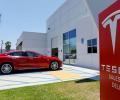
'Gujarat is the frontrunner at present.'
'However, Tamil Nadu's robust automobile ecosystem and Telangana's aggressive incentives make them strong contenders.'
Hyundai Motors India has flown in over 90 robots from Korea to work on assembly lines in its factory near Chennai. The results are better than expectations

Maruti recorded a 13.12% year-on-year surge in average revenue earned per car in 2023 compared to M&M's 7.56%, Hyundai's 6.76% and Tata Motors' 1.88%.

The company currently sells various vehicle brands in the country ranging from hatchback Spark to sports utility vehicle Captiva, priced between Rs 333,000 and Rs 25.71 lakh (Rs 2.57 million), respectivley, (ex-showroom Delhi).
The Monopolies and Restrictive Trade Practices Commission on Thursday advised auto giants Maruti and Hyundai not to target each other in advertisements and asked Maruti to file its reply to a complaint filed by its rival carmaker.

The growth momentum that started during the festival season is likely to sustain in the new year, reports Arindam Majumder.

Clearly, some of the bullishness of the early days has gone missing. Ola's market share is slipping amid rising competition from incumbents like Bajaj Auto and TVS.
Market leader Maruti registers a growth of 19% in 2007.
As the production of Micra, the first car from Nissan-Renault, starts at the plant by the end of May, Kiminobu Tokuyama, managing director and chief executive of Nissan Motor India Pvt Ltd, talks to rediff.com about the company's strategy for India, the recession and the auto sector in general.

HMSI has increased the monthly salary of its permanent workers by Rs 14,770 a month.
India's second-biggest carmaker Hyundai Motor India Ltd on Wednesday raised prices of its two models while market leader Maruti and Czech car firm Skoda announced plans to follow suit next month to meet the rise in input costs and new emission norms.

Maruti, Hyundai, Tata Motors, Mahindra & Mahindra and Honda saw their passenger vehicle sales improve in August compared to the same month last year, although Ford and Toyota witnessed a decline.
India's second-biggest carmaker Hyundai Motor India on Monday said it plans to increase prices by the next month.

Maruti Suzuki's e-Vitara marks its high-stakes EV debut with strong export ambitions, lifting its stock even as analysts caution over pricing and fierce competition.

Passenger vehicle sales are expected to experience muted growth in the current financial year.

Ford India and Renault too reported good sales growth in April
Besieged by rising steel prices, the domestic passenger car manufacturers are gearing up to raise prices again. Barely a month ago, Maruti Suzuki, Hyundai Motors India, Mahindra & Mahindra, Tata Motors and Honda Siel had effected price increases of Rs 6,000 to Rs 30,000 across models.

Industry leaders on Thursday mourned the death of Ratan Tata saying with his demise India has lost a visionary who shaped its industrial and philanthropic landscape. Tata was a truly remarkable business leader who placed the country before business interests, and whose vision was truly transformational for a country and its people, TVS Motor Co Chairman Emeritus Venu Srinivasan said in a statement. "Mr Tata was a truly remarkable business leader, the likes of whom nations get only once in a century," he added.

Fundraising by Indian companies through equity and debt reached an all-time high in the financial year 2024-25 (FY25), according to data collated by primedatabase.com. Fundraising through debt stood at Rs 11.1 trillion in FY25, including contributions from InvITs (infrastructure investment trusts) and REITs (real estate investment trusts).
The new financial year started on a mixed note for car makers.

Maruti Suzuki, Tata Motors, Mahindra & Mahindra, Hyundai and MG Motors are gearing up to introduce EVs in India.

Fundraising by Indian corporates through equity and debt reached all-time high in the calendar year 2024, according to primedatabase.com. The overall public equity fundraising stood at Rs 3.7 trillion in 2024, a rise of 159 per cent from Rs 1.4 trillion in 2023. If Rights Issues of Rs 25,973 crore were to be added, the overall equity fundraising would touch nearly Rs 4 trillion in 2024.
